One Year of Legal Weed in Minnesota: The Report Card
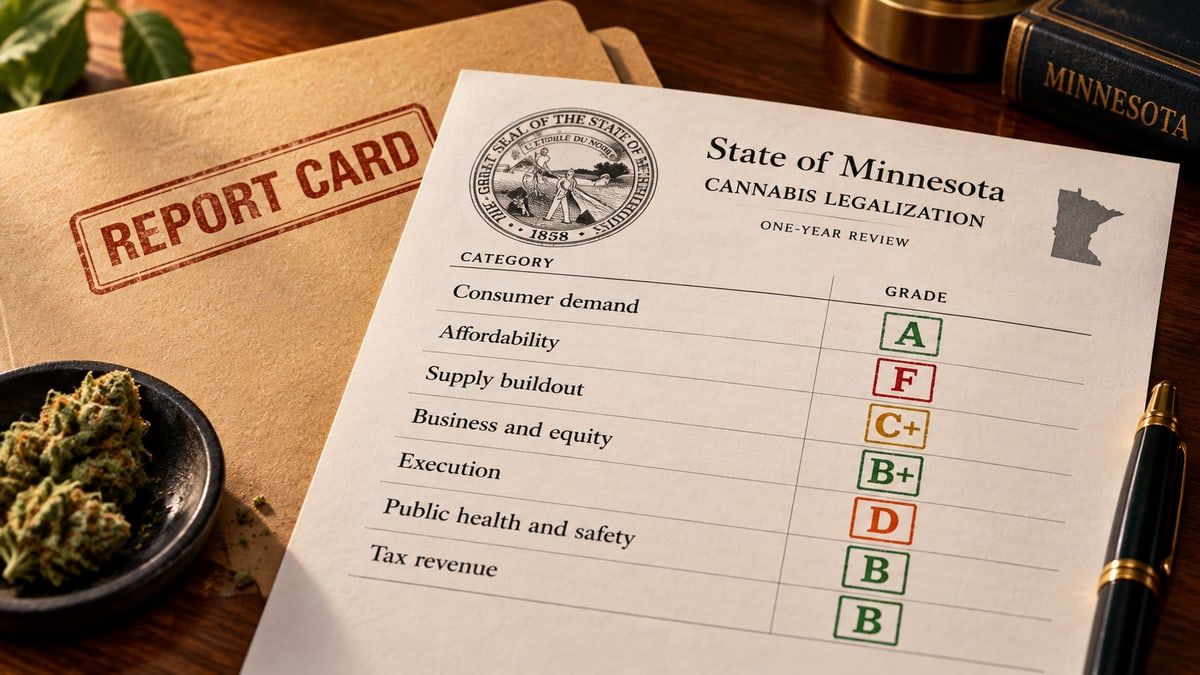
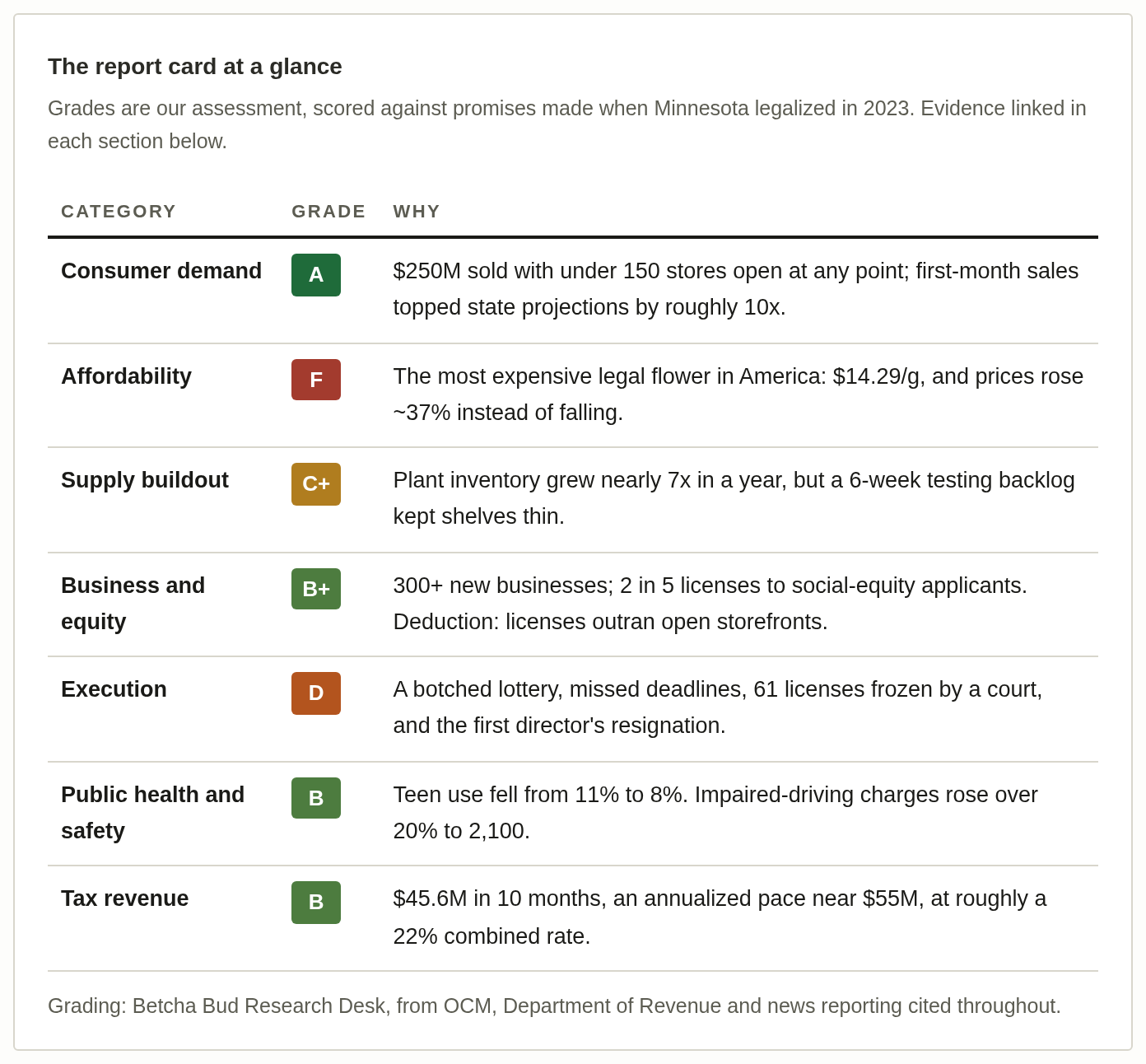
The state sold $250 million of legal cannabis in its first year and collected $45.6 million in taxes. We graded every promise the 2023 law made, using the state's own numbers; demand earned an A and prices earned an F.
On September 16, 2025, Minnesota's first state-licensed recreational dispensaries opened their doors, three years after a crowd of thousands cheered legalization on the Capitol steps. Last month, the Office of Cannabis Management marked the anniversary with a press release: more than $250 million in sales, more than 300 new businesses, $45.6 million in tax revenue. Most coverage repeated those numbers.
The release answered how much the state sold. It did not answer whether the first year delivered what supporters promised in 2023: a market regular people could afford, licenses awarded to the communities the war on drugs hit hardest, a rollout competent enough to keep courts and headlines quiet, and a tax base worth the political fight. So we graded seven categories against the state's own data and the reporting of MPR News, the Minnesota Reformer, KTTC and trade trackers. The headline grade is a pass, financed by consumers who paid the highest legal prices in the country.
A Demand: Minnesotans showed up faster than anyone modeled
The state's own forecasts treated the new market as a slow ramp. Demand treated it like a dam breaking. KTTC reported that the first month of adult-use sales reached $10 million, topping state projections by more than a factor of ten. Sales kept compounding as stores opened: in December 2025, adult-use purchases ($9.4 million) passed medical sales ($8.8 million) for the first time, and the combined market ran at $18.2 million that month. By the middle of 2026, the monthly run rate was above $24 million.
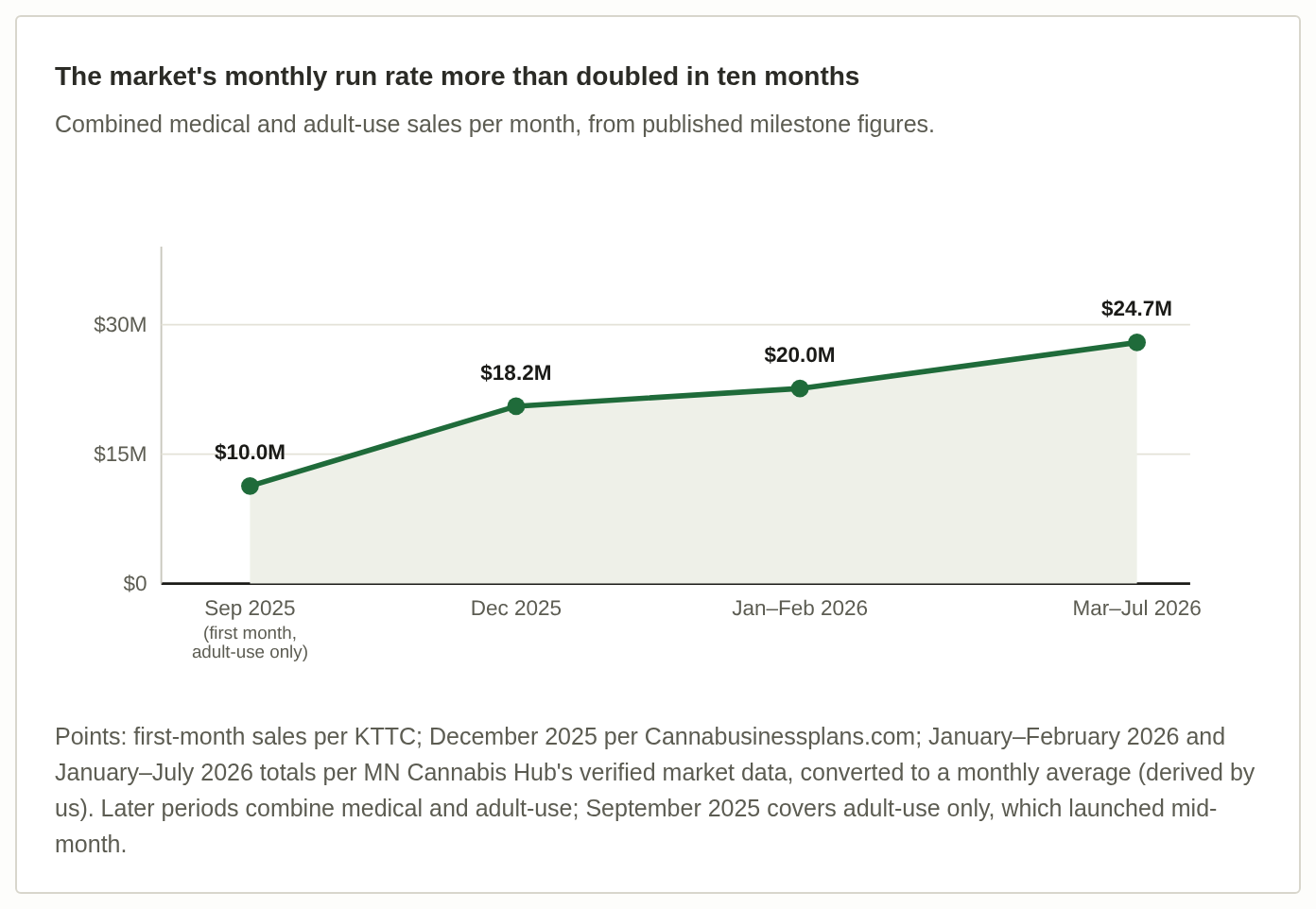
Split $250 million across 5.8 million residents and every Minnesotan, infant included, bought about $43 of legal cannabis in year one; the average adult carried closer to $57 of it. Divide the $150 million adult-use total by the roughly 100 to 130 stores open during the year, and the typical shop rang up $1.2 to $1.5 million, while spending much of the fall running out of stock. Year-one revenue was capped by supply. Minnesota also borders four states without adult-use sales, and industry trackers have spent two years telling operators those neighbors are coming to shop here.
F Affordability: the most expensive legal weed in America
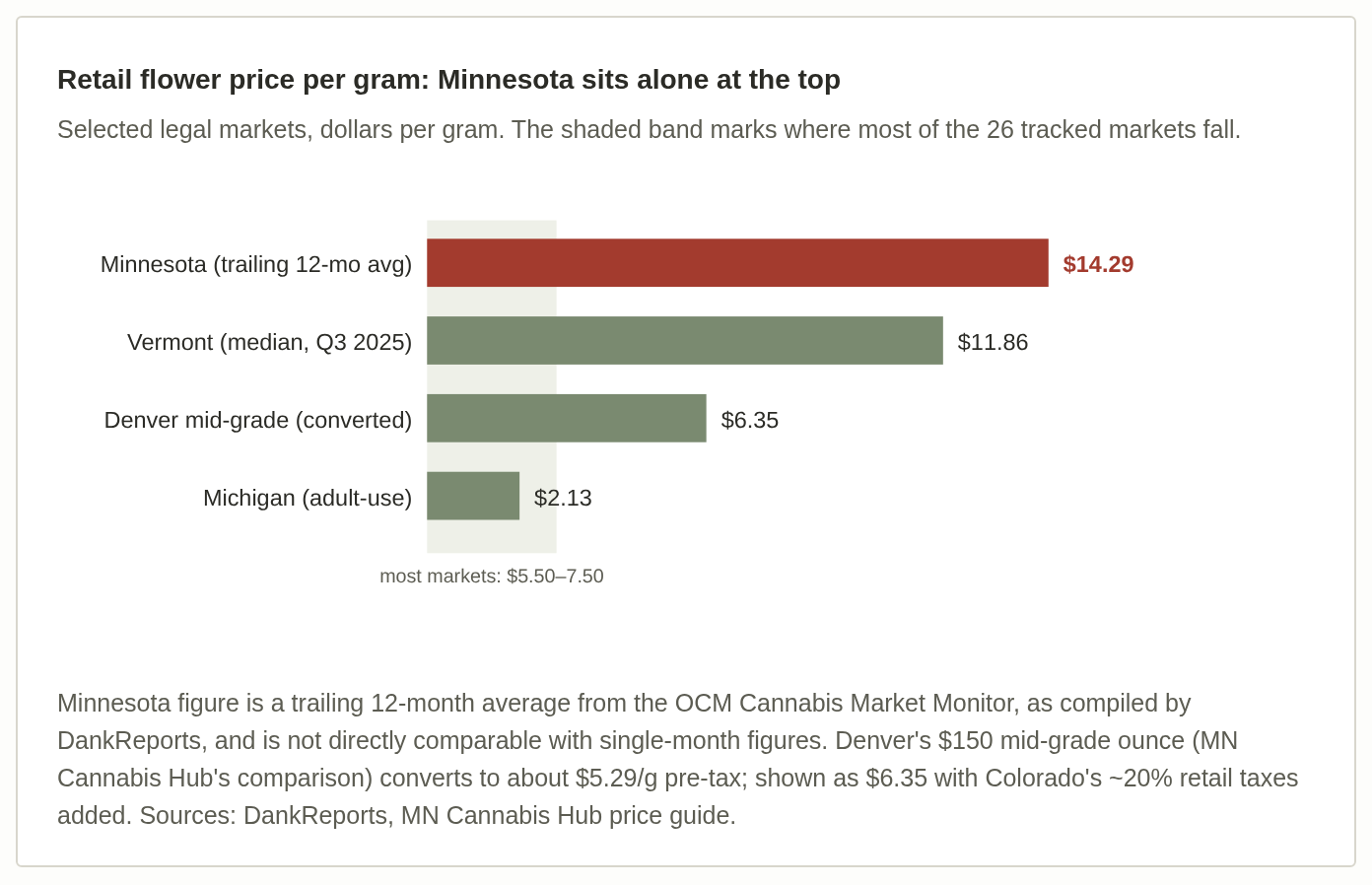
Legalization's core consumer promise was that licensed competition would beat the street on price. Year one delivered the opposite. The state's own Cannabis Market Monitor, tracked by the price service DankReports, puts Minnesota's trailing twelve-month average at $14.29 per gram of flower, the highest of the 26 legal markets measured. Most markets cluster between $5.50 and $7.50. Michigan's floor is $2.13.
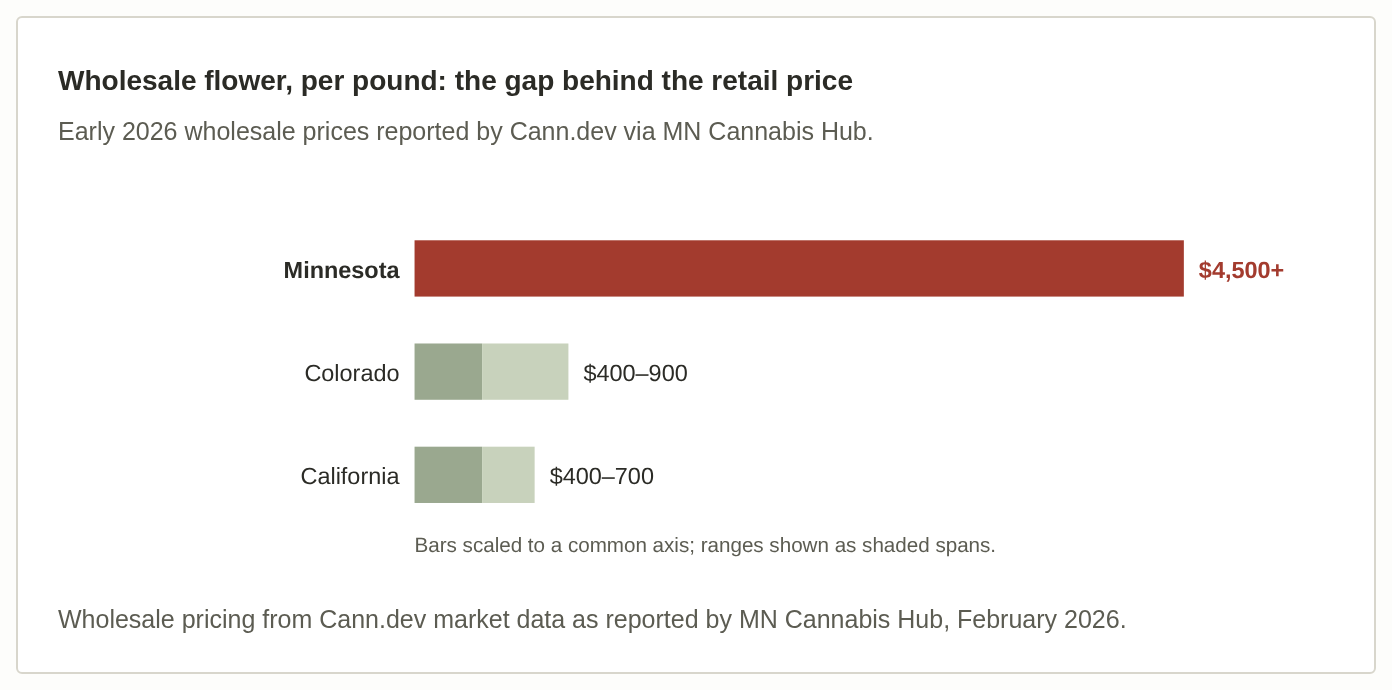
The sticker shock is structural. Wholesale flower in Minnesota ran above $4,500 a pound in early 2026, roughly seven times what mature markets pay. A retailer buying at $280 an ounce before taxes, rent, staffing and compliance cannot sell that ounce for Denver's $150. Add the state's 15% cannabis excise tax (up from 10% last July) plus the 6.875% sales tax and local add-ons, and roughly 22 cents of every shelf-price dollar leaves before the store earns anything.
The sticker shock is structural. Wholesale flower in Minnesota ran above $4,500 a pound in early 2026, roughly seven times what mature markets pay. A retailer buying at $280 an ounce before taxes, rent, staffing and compliance cannot sell that ounce for Denver's $150. Add the state's 15% cannabis excise tax (up from 10% last July) plus the 6.875% sales tax and local add-ons, and roughly 22 cents of every shelf-price dollar leaves before the store earns anything.
And the direction is wrong. Every mature market's first-year story features falling prices as growers scale. In Minnesota, industry analyst Erich Welsch of Cann.dev calculated that average prices rose about 37% over the first year, because licensed demand outran licensed supply. The ounce of mid-grade flower that cost $150 in Denver ran $350 or more in the Twin Cities in early 2026.
C+ Supply: the growers did their job, the pipeline didn't keep up
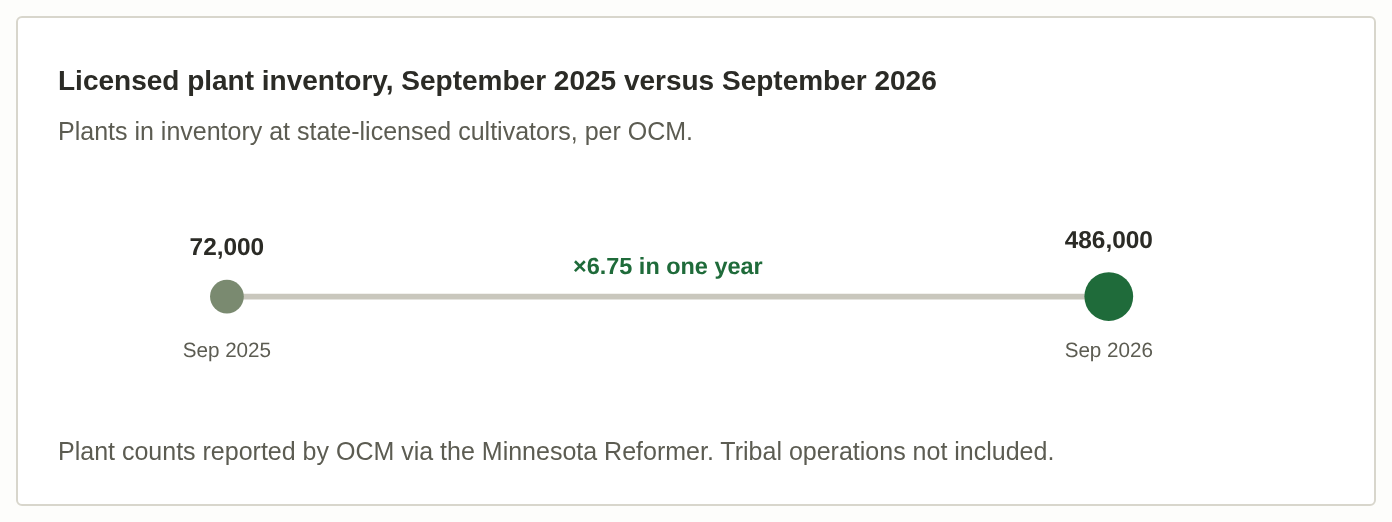
The plants are coming. Licensed cultivators took inventory from about 72,000 plants last September to roughly 486,000 this one, per the Office of Cannabis Management: growth of nearly seven times in twelve months, the strongest reason to think prices eventually correct themselves.
But year one was spent catching up to demand that arrived on day one. In February, only 37 cultivation sites were licensed, many small or still building out, and growers reported lab-testing backlogs of six weeks or more, because every batch must clear potency, pesticide, heavy-metal and microbial testing before it can ship. MPR News reported that six months in, many stores were living on about two weeks of inventory at a time. The C+ splits the difference: the growth rate deserves real credit, and the shelves were still thin when the anniversary arrived.
B+ Business and equity: 300 launches, but licenses outran open storefronts
OCM Executive Director Eric Taubel said more than 300 new cannabis businesses launched in the first year, and the equity numbers are the country's most ambitious to date: more than two in five of all licenses, including cultivation, went to social-equity applicants, a category the Legislature eventually defined broadly enough to cover an estimated third of all Minnesotans, per the Reformer. That breadth invites skepticism about who the program helps, but by raw count the program delivered.
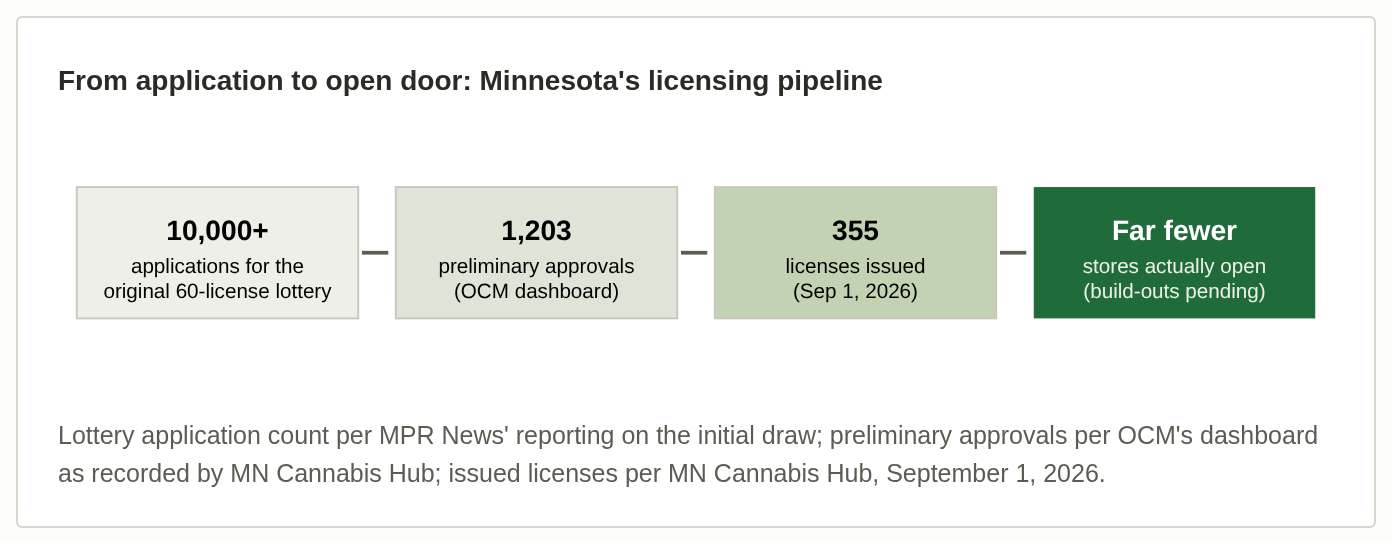
The deduction is the gap between licenses issued and storefronts open. MN Cannabis Hub counted
355 licenses issued as of September 1, 2026, and noted plainly that far fewer storefronts were open: build-outs, local inspections and final operating permits take months. As of February, roughly 1,400 applicants held preliminary approvals and were still waiting to convert. Every one of them is betting on supply arriving soon.
D Execution: the rollout spent most of the year in court
The demand grade and the execution grade describe the same year from different seats. Demand was strong from opening day; the machinery meant to let businesses meet it jammed at nearly every step. The original retail lottery drew more than 10,000 applications for 60 licenses. Licenses promised by March 23, 2026 did not arrive on time, unsuccessful applicants sued, and in July a court ruling froze 61 newly drawn retail licenses while challenges were sorted. Days later, Charlene Briner, the first director of the Office of Cannabis Regulation, resigned amid what MPR described as license chaos, with oversight consolidated under OCM and remaining draws running months behind.
The state's defense is that courts caused the delays, and that a lottery this contested had no clean path. That may be true, but year one's costs were paid by the applicants who financed leases around a March deadline that slipped, and by the consumers whose prices stayed high because stores couldn't open. Thirty-nine cities now allow cannabis retail and 29 have banned it, MPR reported at the anniversary, so the map of where stores can exist is still being argued block by block. Anoka opened the state's first government-run dispensary in February; more than a dozen other cities and counties have explored following it.
B Health and safety: teens bought less, roads got riskier
Legalization's skeptics predicted a youth surge. Instead, the Minnesota Department of Health's student survey found past-30-day marijuana use among middle and high schoolers fell from 11% in 2024 to 8% in 2026, continuing a decline that predates retail sales. That is the strongest single public-health data point of the year..
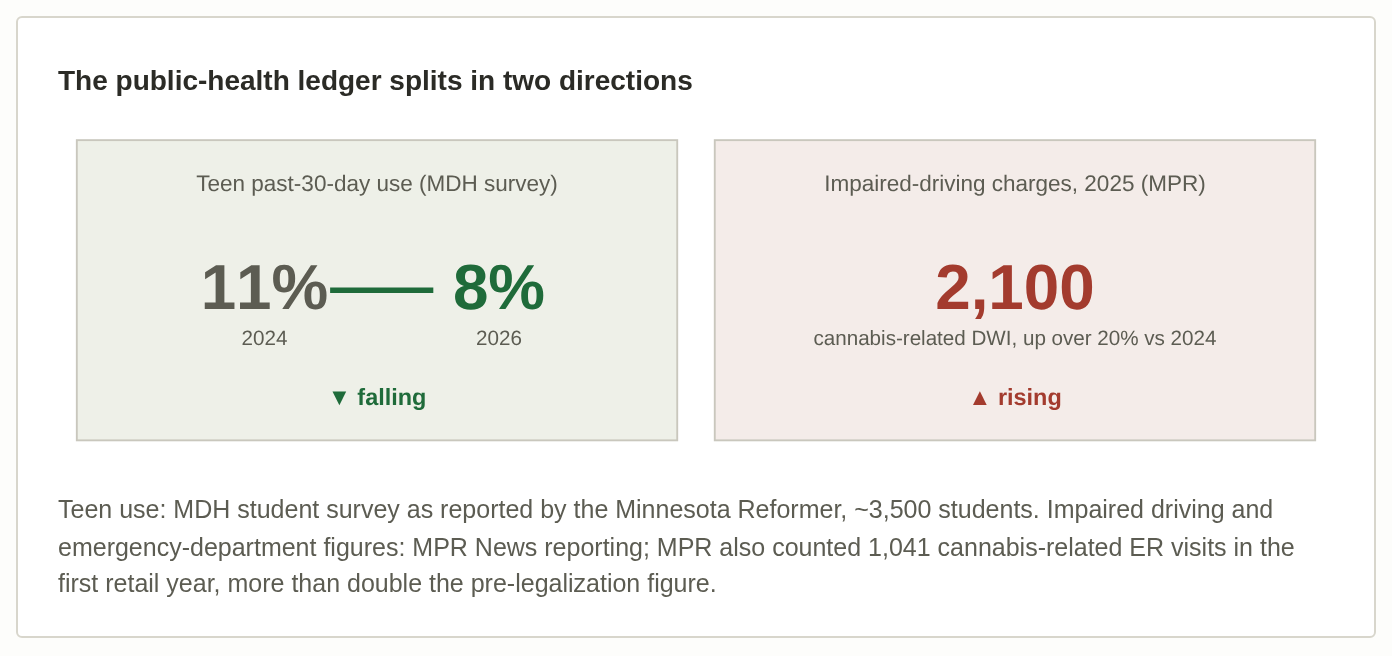
The costs concentrated on roads and emergency rooms. MPR News reported that 2,100 people were charged with cannabis-impaired driving in 2025, up more than 20% from the year before, and that emergency departments logged 1,041 cannabis-related visits in the first retail year, more than twice the pre-legalization count. Some of that rise is detection and reporting catching up to a newly legal product. The direction still matters, and the state's own public-safety messaging has not kept pace with its marketing of the market.
B Tax revenue: $45.6 million in ten months, with a catch
The Department of Revenue collected $45.6 million in cannabis-related taxes from September 2025 through July 2026, a pace of roughly $55 million annualized, at a combined rate around 22% once state and local sales taxes join the 15% excise tax. The total blends in taxes from lower-potency hemp drinks and edibles, whose sales are not tracked in the state's seed-to-sale system, so the true take from licensed marijuana alone is smaller than the headline. And that hemp segment, the one generating real tax dollars at gas stations and liquor stores, is scheduled to be banned federally on December 11 unless Congress acts again, which would move those dollars toward licensed stores or off the books entirely.
C+ Overall: year one passes, with consumers paying the country's highest legal prices
Affordability, execution and safety data are where the year lost points. The pattern across the grades is one story. Demand arrived early, and every system meant to answer it ran late.
What year two should fix, and where to shop until then
The mechanics for relief already exist. Macro-business licenses arrive January 1, 2027 under the May 2026 omnibus bill (HF4203), which also merged the medical and adult-use supply chains and let hemp businesses convert into licensed cannabis operators. The 1,400-plus applicants with preliminary approvals are the competition that compresses prices. Analysts at MN Cannabis Hub expect meaningful price declines starting late 2026, with sharper drops through 2027, the same trajectory Colorado took when its wholesale market matured, though Colorado's prices fell about 70% over a full decade, so nobody should expect Denver prices by next summer.
Prices are a supply problem, so shop where the tax burden is lower: tribal dispensaries are exempt from the state excise tax and run roughly 15 to 22% cheaper at the register, and a medical cannabis card removes the excise tax for qualifying patients. Buy closer to the two-ounce possession limit per trip rather than a steady stream of small purchases. And mark December 11: when the federal hemp ban lands, the $3 seltzer aisle disappears, and the question becomes how fast licensed supply can absorb those shoppers.
Methodology: grades are our editorial judgment applied to public data, and the state has not issued an official scorecard. Figures come from the Office of Cannabis Management and Department of Revenue as published September 15, 2026, and from reporting by MPR News, the Minnesota Reformer, KTTC, FOX 9, Marijuana Moment, MN Cannabis Hub, Cann.dev and the DankReports price tracker. Derived figures (monthly run rates, per-resident spending, per-store revenue, tax-adjusted Denver price) are labeled as such. MPR News articles referenced were not independently re-verified by us and are cited as that outlet's reporting.
Sources
- FOX 9: Minnesota cannabis sales top $250 million over 10-month period (Sep 15, 2026)
- Minnesota Reformer: Minnesota recreational cannabis sales hit $150M one year in (Sep 15, 2026)
- Marijuana Moment: Minnesota dispensaries have sold over a quarter billion dollars of marijuana since legal sales launched (Sep 15, 2026)
- MN Cannabis Hub: Why Minnesota dispensary prices are high in 2026 (Feb 2026)
- MN Cannabis Hub: Minnesota cannabis price guide for 2026
- MN Cannabis Hub: Minnesota cannabis market data dashboard
- DankReports: Cannabis prices by state (state regulatory data compilation)
- Office of Cannabis Management: Cannabis Market Monitor dashboard
- KTTC: Minnesota cannabis sales top projections in first months of adult-use market (Apr 2026)
- KTTC: Court ruling holds 61 new Minnesota cannabis retail licenses (Jul 2026)
- MPR News: Minnesota's first cannabis regulator resigns amid license chaos (Jul 23, 2026)
- MPR News: Legal marijuana is limited and expensive in Minnesota six months after sales began (May 28, 2026)
- Minnesota Reformer: State survey finds teen use of marijuana since legalization is going down (Aug 3, 2026)
- Cann.dev: Minnesota retail market overview
- Erich Welsch (Cann.dev): Minnesota cannabis prices rise 37% in first year
- Cannabusinessplans.com: Minnesota cannabis market statistics (December 2025 monthly figures)
Researched and written by the Betcha Bud research desk in Minneapolis. We publish market analysis we would want to read ourselves. Numbers current as of October 1, 2026; corrections at our desk any time.
Shop by Category
Recommended For You
Additional Recent Posts